
How To Make Wood Pellets?
Want to know how to make wood pellets? Wood pellets are a clean and environmentally friendly biomass fuel that can be made from a variety of wood-based materials. This article will provide a detailed explanation of how to make wood pellet from 11 different raw materials, including sawdust, wood chips, wood powder, logs, branches, tree tops, forestry waste, shrubs, wooden pallets, and construction wood waste, helping you make full use of various wood resources to produce high-quality biomass fuel.
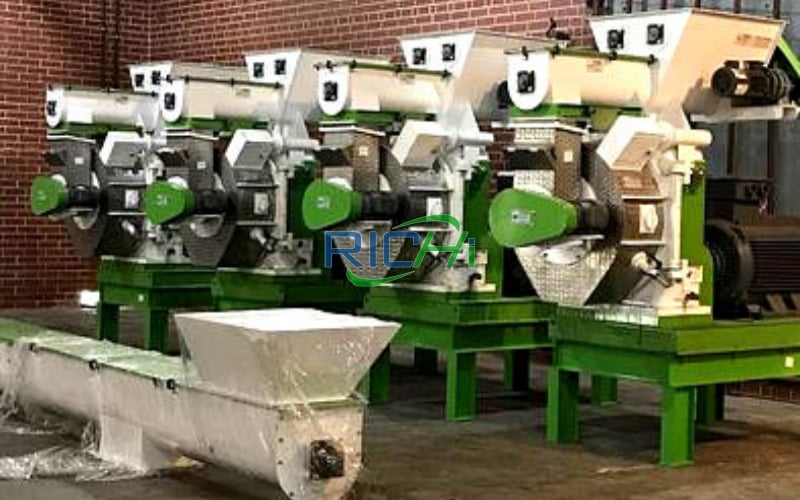
Project Images of a Wood Pellet Production Line
The image on the right shows a 10-ton/hour wood pellet production line project we configured for a US client. Based on the client’s capacity requirements and raw material characteristics, we equipped this project with four wood pellet machines to meet the requirements of continuous and stable production.
If you would like to learn more about the specific process scheme, equipment selection, or configuration logic for this project, please feel free to contact us. We will tailor the most suitable wood pellet production solution for your needs based on your raw material type, capacity target, and actual operating conditions.
How to Make Wood Pellets from Multiple Raw Materials?
One of the biggest advantages of wood pellet production is the flexibility in raw material usage. You don’t need to rely on a single source of wood. In fact, many successful pellet producers mix different materials to optimize costs, improve pellet quality, and ensure a stable supply. Mixing sawdust with wood chips, combining softwood with hardwood, or using forestry waste with construction wood waste can all help you achieve better pellet density, higher calorific value, and more consistent production.
√
How to Make Wood Pellets from Sawdust
Sawdust is a powdery waste material produced when lumber mills saw wood, and it is one of the most ideal raw materials for making wood pellets. The manufacturing process is relatively simple because the sawdust particles are already very fine, usually between 1-3 millimeters, and can be directly used for pelletizing without the need for crushing. Wood pellets made from sawdust have a smooth surface, high density, and good combustion efficiency, making them one of the most popular products on the market.
√
How to Make Wood Pellets from Wood Chips
Wood chips are small pieces of wood material obtained by chipping logs or branches, typically 5-30 millimeters thick. The advantages of wood chips are that they are easy to transport and store, occupy relatively little space, and their moisture content is relatively easy to control. After processing the wood chips into 3-5 millimeter wood shavings using a crusher, they can be granulated according to standard procedures.
√
How to Make Wood Pellet from Wood Powder
Wood powder is a finer wood powder, usually with a particle size smaller than 1 mm. Making wood pellets from wood powder requires careful control of moisture content. Wood powder has a large surface area, making it prone to absorbing or losing moisture, resulting in significant fluctuations in moisture content.
√
How to Make Wood Pellets from Logs
Logs refer to complete, unprocessed timber after felling. First, the logs are chipped into wood chips using a chipper, then crushed into sawdust, and finally granulated. The advantage of using logs is that the quality is controllable; high-quality tree species can be selected, resulting in stable calorific value of the finished pellets.
√
How to Make Wood Pellets from Tree Branches
Tree branches are a type of waste material generated from forestry harvesting and garden pruning. Making wood pellets from tree branches requires chipping and then crushing the branches.
Tree branches are widely available and inexpensive, especially in forest and orchard areas, where large quantities of branches are generated annually through pruning. Converting branches into pellets solves the waste disposal problem and creates economic value.
√
How to Make Wood Pellets from Forestry Residues
Forestry waste refers to various types of woody waste generated during forestry production. Making wood pellets from this waste is an important way to fully utilize forest resources. Forestry waste includes logging residues, thinning materials, diseased and rotten wood, and bark. Collecting forestry waste to make wood pellets not only improves the forest environment but also creates economic benefits, achieving the circular utilization of forestry resources.
√
How to Make Wood Pellet from Bushes
Bushes are a type of low-growing woody plant, and this project is suitable for areas with abundant shrub resources. Clearing wasteland, road landscaping, and pruning of windbreaks in agricultural fields all generate large quantities of shrub branches. Bushe branches are typically thin, with a diameter of 1-5 cm, low density, and highly variable moisture content. After chipping and crushing the shrubs, they need to be thoroughly dried before pelletizing.
√
How to Make Wood Pellets from Wooden Pallets
Wooden pallets are common wooden carriers in logistics and transportation, and they often become damaged or unusable after a period of use. Most wooden pallets are made of softwood materials such as pine and fir, and their stable wood structure makes them a high-quality source of raw materials for making wood pellets.
Before formal processing, wooden pallets need to undergo standardized pretreatment. Since pallets usually contain nails and metal fasteners during use, these can be removed during the production process using specialized nail removal equipment and metal separation systems. This effectively removes impurities and ensures the safe and stable operation of subsequent crushing and pelletizing processes. The processed wooden pallet raw materials can then be further crushed, dried, and made into high-density, high-efficiency wood pellets, achieving the reuse and value enhancement of wood resources.
After reading about the different raw materials, you may have some questions: Which equipment is suitable for my raw materials? What auxiliary equipment is needed? What is the estimated total investment? How long will it take to recover the costs? How can I guarantee product quality? The answers to these questions depend on your specific situation—the type of raw materials, moisture content, supply stability, target production capacity, investment budget, etc. There is no one-size-fits-all answer, only the most suitable customized solution for you.
We understand the processing characteristics of different raw materials and know how to optimize equipment configuration, helping you avoid common technical pitfalls. Contact us now! Tell us what raw materials you have available and your planned investment, and we will tailor a production plan for you based on this information, providing a detailed equipment list and investment budget.
How to Make Wood Pellets
The complete wood pellet production line is not simply “crushing + pelletizing,” but a continuous, controllable industrial process. From the raw materials entering the factory to the finished pellets leaving the warehouse, every step directly affects the molding rate and combustion performance of the wood pellets.
1
Raw Material Entry and Preliminary Sorting:
After the wood raw materials enter the production line, they are first sorted manually or mechanically to remove obviously unsuitable large pieces of debris.
2
Nail and Metal Impurity Removal:
For raw materials such as wooden pallets and construction timber that may contain nails, screws, and metal fasteners, a dedicated nail removal and metal separation section is required. Through magnetic separation devices and other equipment, metal impurities in the wood are effectively separated, preventing metal from entering the crushing and pelletizing system.
3
Coarse Crushing and Size Pre-treatment:
After metal removal, the wood enters the coarse crushing section, usually using a wood crusher or a comprehensive crusher to break down large pieces of wood into wood chips or coarse particles.
4
Fine Crushing:
The coarsely crushed wood is sent to crushing equipment to process the raw materials into uniform wood chips or wood powder. The appropriate particle size improves pelletizing efficiency while ensuring the density and stability of the pellets during the molding process.
5
Moisture Content Adjustment:
The crushed raw materials need to enter the moisture adjustment section. Through drying, the moisture content of the raw materials is stabilized within a range suitable for pelletizing.
6
Pelletizing and Molding:
The processed wood chips are sent to a wood pellet machine. Under high temperature and high pressure conditions, the wood fibers undergo physical bonding and are continuously pressed into regular cylindrical wood pellets. The pelletizing process is the core of the entire production line and requires high demands on equipment stability and process parameters.
7
Cooling and Shaping:
The pellets just out of the pelletizing machine have a high temperature and their structure is not yet fully stable. They need to enter a cooling system for cooling and shaping. Through cooling, the pellet strength is further improved, the surface becomes smoother, and the subsequent breakage rate is reduced.
8
Screening and Recycling:
The cooled pellets are passed through screening equipment to separate out powder and unqualified pellets. The screened material can be returned to the pelletizing section for reprocessing, achieving efficient utilization of raw materials.
9
Finished Product Storage and Packaging:
The qualified wood pellets enter the finished product storage system and are stored in bulk or automatically weighed and packaged according to requirements, facilitating transportation, sales, and end-use.
Why Choose RICHI Machinery?
RICHI Machinery has been deeply involved in the pellet manufacturing industry for 30+ years. Its customers are spread across Europe, America, Africa, Asia Pacific, Middle East and other regions, and its sales network covers more than 140+ countries and regions. It has successfully completed more than 1,200 complete sets of pellet projects with a high level of professionalism, making it a recognized leader in the industry.
Efficient and comprehensive after – sales service:
RICHI Machinery has a comprehensive and well – established after – sales service system. It has multiple overseas logistics routes to ensure that machine arrives safely and on time. Later on, if there’s any abnormality with the customer’s machine, we’ll provide after – sales staff to offer preliminary solutions right away. And within 48 hours, we’ll send professional technicians to the site (within China) for service, minimizing the customer’s downtime.
Scientific customized services:
We have a diverse and rich product system. With over 200 products, we can meet the needs of various biomass production customers. The company is equipped with a professional R&D and design team. According to your actual situation, whether it is a small feed factory or a large industrial feed factory, we will design personalized solutions for you based on the actual situation.
Excellent equipment quality:
RICHI Machinery has won many international authoritative certifications. The company has passed BV certification, ISO9001 International Quality Management System Certification, European CE Certification, and Swiss SGS Certification, among others. You can find us on YouTube.